

It’s Monday, and your stomach already knows that your presentation is this Thursday.
You know the material. You’ve rehearsed all your key points. You’ve tried to ignore the negative thoughts that run through your mind like a bullet train every ten minutes. Even so, every time you picture the room, your heart speeds up, and your mind goes blank on almost all your main points.
You may even have done the obligatory 11 pm Google search for “how do I stop shaking when I present” or “why do I panic even when I know my stuff.” You’re tired of losing sleep over twenty minutes of slides, and you want something more useful than “just relax and take deep breaths.”
The thing is, you probably won’t get rid of the nerves completely. But you can make sure they stop running the show. Below is a practical method that works with your nervous system.
TL;DR
- Presentation anxiety is your threat system misreading a meeting room as danger. You can retrain it with practice that matches the real conditions, slow breathing, and a fixed routine for both before you start and in the moment, during your talk.
- Rehearsing frequently, out loud, standing up, with someone watching or a camera running does help, but it’s only part of the presentation preparation picture.
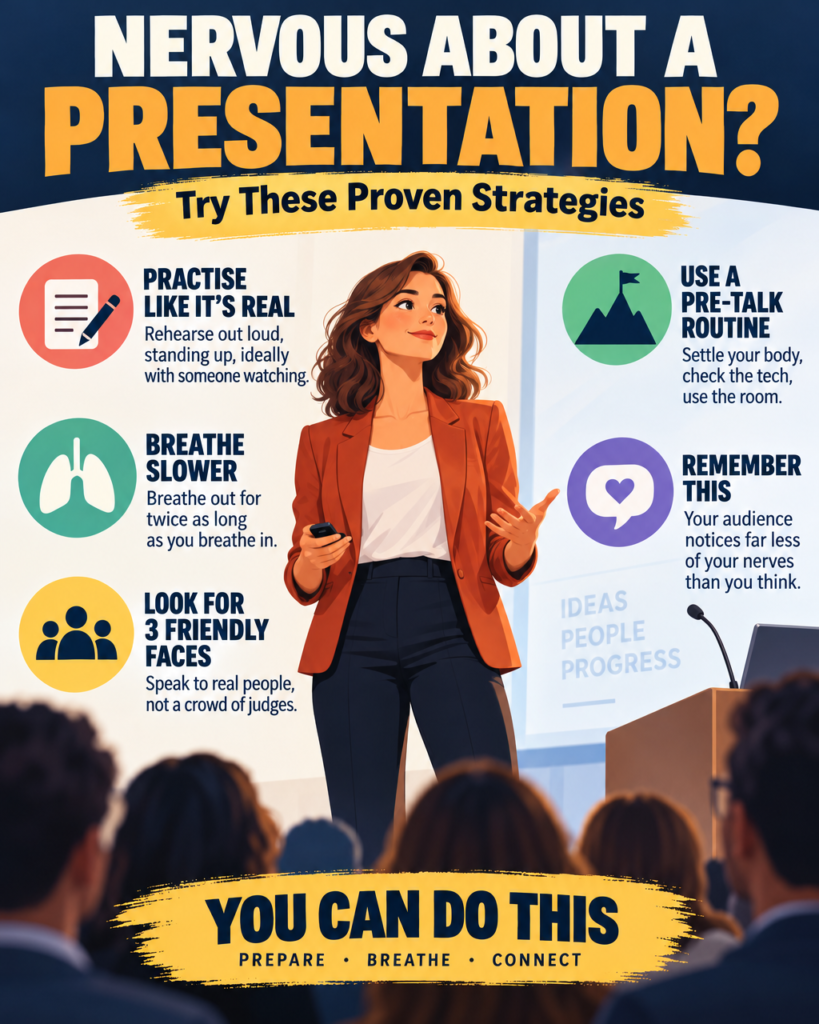
- Long exhales calm your body faster than any well-intentioned water-cooler pep talk with your work bestie. Aim to breathe out for twice as long as you breathe in.
- Audiences notice far less of your nervousness than you think. Look for and speak to three friendly faces. This trains your brain somewhat to stop scanning for judges.
- If the fear makes you avoid work, lose sleep for days, or have panic attacks, CBT for social anxiety has a strong record and is worth pursuing.
Talk coming up in the next few days? If you’d rather not piece this together alone, a Presentation Comeback Session gives you a plan for the moments that usually throw you.
Understanding Presentation Anxiety
Presentation anxiety is the stress response that kicks in before or during public speaking. It’s also called performance anxiety or glossophobia. Your body releases adrenaline and cortisol, which raises your heart rate, speeds up your breathing, tightens your muscles and pushes your attention outwards to look for perceived threats to your survival.
The trouble is that this response evolved to deal with predators. It’s very good at helping you sprint away from something very hungry with very sharp teeth. It’s much worse at helping you eloquently explain quarterly forecasts to your board of directors.
Think of it as an overly keen smoke alarm. A real fire and a slice of burnt toast set it off just the same. Your brain hears “forty people will look at me and judge me” and gets the fire engines ready.
Three things are worth knowing from the start:
- It’s extremely common. Fear of public speaking regularly comes top or near the top of lists of what adults dread most, sometimes right behind a fear of death. That says a lot about how seriously humans take public embarrassment and negative judgment.
- It runs on a sliding scale. Some mild nerves sharpen your focus. The problems start when the arousal gets so high that your working memory goes, which is where the classic mind blank comes from. You can experience more nervousness in some contexts than you might in others. For example, some speakers are more comfortable one-on-one, while others feel like they’re under an intense spotlight.
- It’s learnable in both directions. Avoiding presentations teaches your brain the danger was real, and therefore the next one feels even scarier. Giving presentations and coming through them successfully teaches it to dial things down the next time.
What Causes Presentation Anxiety and Stage Fright
Speech anxiety usually comes from a handful of predictable triggers. Working out which ones apply to you tells you where to aim your effort.
| Cause | How it sounds in your head |
|---|---|
| Fear of negative evaluation | “They’ll think I’m incompetent.” “They’ll know I’m a fraud” |
| Spotlight effect | “Everyone can see my hands shaking.” “They all see right through me” |
| A bad past experience | “Last time I froze, so I’ll freeze again.” “Don’t mess this up like you did last time” |
| Perfectionism | “If I stumble once, the whole thing is ruined.” “I have to get the opening hook right” |
| Low familiarity with the material | “What if they ask something I can’t answer?” |
| High stakes | “My promotion depends on this one talk.” |
| Temperament and anxiety sensitivity | “My heart is racing, so something must be wrong.” |
| Lack of reps | “I present maybe twice a year.” |
Many people also fear the symptoms more than the talk itself. Your racing heart gets read as proof of danger, so the anxiety grows, and so does your heart rate. It’s a feedback loop, like a microphone held too close to its speaker.
Got a presentation coming up this week? Reading about what to do in the moment is one thing. Knowing what actually works for your body when your mind goes blank is another. In a Presentation Comeback Session, we work on the moments that usually throw you: the shaky opening, the blank, the tough question. It all happens by Telegram voice notes, so it fits around your week.
Practice and Preparation
Good preparation cuts anxiety in two ways. You have fewer unknowns, and your brain collects evidence that you can do this. The key is to rehearse in conditions as close to the real thing as you can manage.
- Write an outline, not just a script. If you’re like me, a script is necessary to get all the thoughts out. But memorising a script word for word risks you sounding robotic, and you get lost the moment you forget a word or realize you’ve skipped a bit. Transfer that script to an outline. Keep one line per point. This allows you to speak from your knowledge – to ad-lib on some level and removes the pressure of speaking from rote memory.
- Memorise three things word for word. I call these your anchors. Your opening two sentences, a key or complex point or transition, and your closing line. Those first two are the moments when nerves can peak, and having a sense of being on autopilot there is a mercy.
- Rehearse out loud and standing up. Running through it silently in your head is like learning to swim on a sofa. Your mouth, legs, and breath all need practice, too. What do I mean by that? Let’s take that from the ground up. Practicing standing up means you also get to practice standing in a grounded, stable way. More on that later. Practicing out loud has numerous advantages, two being you get to figure out when you can properly exhale, and also how the words actually feel – is there anything you need to re-word in order to say it more clearly?
- Add pressure gradually. First, rehearse alone. Then to a mirror. Then record yourself on your phone – audio, then video. Then do it for one friend, and then for a small group. Each step is a small dose of the real fear. But they only take you so far because you’re still in an environment associated with some sense of safety (home, friends – all things your nervous system accepts as non-threatening). If you can, visit the actual room you present in and run through it there. Better yet if some strangers are milling around.
- Practise recovering. When you lose your place during a run-through, pause, push down through your feet, relax your shoulders, breathe out fully, check your notes, and carry on. Notice how that little routine makes you feel, and what it does to your internal dialogue. This takes the fear out of losing your place, because now you have a plan to stay on track.
- Prepare for the five questions you dread most. Write answers that use short, simple sentences and that take you through a clear beginning, middle, and end. For anything you can’t predict, have a stock line ready, such as “Good question. Let me check and come back to you by Friday.”
- Visit the room or test the tech. Find out where the clicker is, whether the HDMI cable fits, and where you’ll stand. Every detail you settle beforehand is one less unknown on the day.
Aim for four to six full run-throughs. Beyond that, extra repetition tends to tip into over-polishing. It might even make the fear worse because with each new run-through, you risk a new slip-up and therefore a new doorway to tell yourself you’re going to mess this up. Not great for a nervous system that we are trying to settle, not rattle. And nobody has ever been asked to leave a meeting for being slightly less than perfect.
Breathing and Relaxation Exercises
Breathing is the quickest route into your nervous system. Lengthening your exhale activates the parasympathetic branch (your rest-and-digest response), which slows your heart rate. You can feel the difference within a minute or two.
Note: breath work can carry potential risks with certain contraindications, so please consult with your trusted medical professional first before trying any practice.
- Physiological sigh: Take two short inhales through the nose, then one long, slow exhale through the mouth or nose. Do it one to three times. Nobody will notice you doing it. I use this when someone is asking a challenging question, or Chad has yet again interrupted me in the meeting.
- Extended exhale breathing: Breathe in for four counts and out for anywhere between five to eight (practise this to find out what feels comfortable for you). Keep it going for two to five minutes before you speak. A longer exhale is the part that tells your body to slow down, that you’re OK – this is just a meeting room, not a life-or-death situation.
- Box breathing: Breathe in for four, hold for four, breathe out for four and hold for four. It’s useful when your thoughts are racing, because the counting gives your mind a job.
Practise these at least once daily during the weeks before the talk. Practise it first in moments of ease and comfort (like that glorious moment getting into bed). Your nervous system will associate the practices with steadiness, and will treat them as something familiar to reach for when you’re mid-presentation. If you only try a breathing technique for the first time while panicking, it’s like reading the fire extinguisher instructions after the curtains are ablaze.
Body Language and Physical Techniques
Managing presentation anxiety is less about the positive self talk and much more about using the right breathing exercises and getting really intimate with recognising and manipulating certain physical sensations. Your posture and movement send signals back to your brain as well as out to the audience. Adrenaline also needs somewhere to go, so these physical techniques give it a job to do before it decides to run the whole show.
| Symptom | What to do about it |
|---|---|
| Shaking hands | Hold a clicker or pen, or rest your hands lightly on the lectern. Avoid holding loose paper, which turns a small tremor into a visible flutter. If your audience sees that, they too may start to feel on edge or a little anxious. |
| Shaky voice | Breathe and speak from your diaphragm, a little slower and a touch lower than usual. Belly Breath works wonders on gettting good at this. Hum quietly beforehand to warm up your vocal cords. Humming Bee Breath is a fantastic way to do this – it warms up the vocal cords and slows down your breath at the same time. |
| Dry mouth | Keep water within reach. Biting your tongue gently or thinking about a lemon apparently triggers saliva, but to be honest, I prefer a moment of warm water, as there is less risk of me grimacing as I imagine a sour lemon. |
| Racing heart | Walk briskly or climb a flight of stairs ten minutes before. Using up some adrenaline takes the edge off. If stairs or space to walk aren’t available, then my go-to is some standing stretches – simple twists and side bends. |
| Locked knees | Stand with your feet hip-width apart and your knees slightly soft. Really push down through your feet and lift up through your chest. Relax your shoulders down and keep your chin parallel to the floor. This is a grounding yoga pose called Tadasana – or Mountain Pose- and helps to settle a rattled nervous system. |
Managing Audience Connection
The audience feels most threatening when you unintentionally picture them as a single jury out to convict you for a crime you didn’t commit. Breaking that picture down into individual, mostly distracted, definitely tired humans takes away a lot of its power.
- Remember the illusion of transparency. Research by psychologists including Thomas Gilovich has shown that speakers consistently overestimate how much of their nervousness the audience can see. Your internal earthquake of nerves mostly registers as a slight tremor on the outside, if anything.
- Find three friendly faces. Pick one on the left, one in the centre and one on the right. Rotate between them. Nodders are gold.
- Tell a story. This is a trick I teach all of my uni students to manage public speaking anxiety. Start your presentation with a seemingly unconnected story from your life, preferably one with a little vulnerability in it, and several things happen. The sense of nostalgia and the act of reminiscing settles your nervous system. You breathe better, you speak slower. You’re ad-libbing because this is something you’ve lived, so that robotic tone of rote memorization is gone. A story makes both you and your audience feel something increasing the connection between you and them. And it automatically has them flip through their own mental Rolodex of similar events, making you suddenly very relatable, and perhaps more importantly, memorable.
- Make it about them. Ask yourself what the audience needs to understand or decide by the end. Anxiety is self-focused, so turning your attention to their problem crowds it out. Jess Ekstrom calls this the Lighthouse effect.
- Ask an early question. A show of hands in the first two minutes turns a monologue into a conversation and, cheekily, gives you a breather.
- Read the room correctly. Blank expressions are a typical meeting face. People look like that during a weather forecast, too. Folded arms often just mean the air conditioning is set to “Antarctic.” Frowns mean the chairs are predictably uncomfortable. It’s important to check the story you’re telling yourself against the actual cold hard facts of the room. This takes a lot of the initial anxiety away.
I am of the firm belief that most people are mostly good. Most audiences are rooting for you and want you to do well, if only because watching someone struggle is uncomfortable for everyone. They’re on your side by default.
Before the Presentation Routine
A fixed routine before you speak turns the scary unknown into something predictable, something somewhat controllable. Pilots use checklists for the same reason. Under stress, you shouldn’t be making decisions you could have made in advance.
- The night before: Do one relaxed run-through, no more. Lay out your clothes, charge your laptop, and get to bed on time, if not early. Late-night cramming mostly gives you new things to worry about. A rested nervous system is harder to rattle.
- The morning of: Eat a proper breakfast with protein. Go easy on the caffeine, since it mimics anxiety symptoms almost perfectly and your body won’t know the difference. Spend some time in silence, paying attention to what you can hear, see, and touch. This brings you into the here and now and gives you a break from worrying about how the presentation will go.
- One hour before: Go for a ten-minute walk, or find somewhere private to do some stretches. Side-bends, gentle twists, and easy forward folds all work to loosen up the torso, meaning you will breathe deeper, which will help settle you. Review your opening lines and the three things you memorised. Then close the notes.
- Twenty minutes before: Arrive, test the tech if you can, and get some water ready. Talk to a couple of early arrivals to establish rapport and also warm up your vocal cords.
- Five minutes before: Plant your feet, and really feel yourself push the floor away. Drop your shoulders as you do three physiological sighs, and make sure to fully exhale everything out on each one.
- Sixty seconds before: Tell yourself, “I’m excited.” Harvard researcher Alison Wood Brooks found that people who reframed their anxiety as excitement performed better than people who tried to calm down. Excitement and anxiety feel nearly the same in the body, so the swap is easier for your brain to believe than “I’m calm.” If that doesn’t fit, then label whatever sensation you’re feeling with specificity. I use the framework “My (body part) is (action) and it feels (sensation). For example, “My stomach is churning and it feels white hot.” This is called affect labelling.
During the Presentation Techniques
Even with good preparation, things go wrong while you’re speaking. Treat each problem as a scenario with a ready-made fix.
If your mind goes blank: Pause, take a sip of water, exhale everything out slowly, and look at your outline. A three-second pause feels like a minute to you and looks like considered thoughtfulness to everyone else. If you still can’t find your place, summarise the last point you made. Repeating it often jogs the next one loose. Above all, remember to drop those shoulders down.
If your voice shakes in the opening: Slow down – both your speech and your breath. Nerves speed up your speech, and slower speech sounds more assured. The shake usually fades within the first two minutes once your breathing settles.
If you make a mistake: Correct it in a single sentence and carry on. “Sorry, that’s 2023, not 2024.” Unless you dwell on it, the audience will forget it before you do.
If someone asks a question in a challenging or hostile manner: Work on slow long inhales and exhales as they speak. Belly breath is a great practice to bring in here, but not first time you’re trying it. These breaths will help keep you settled, keep your mind clear, and focus on giving a full, succinct answer without reacting to their tone.
If you notice someone frowning: Assume they’re thinking hard, short-sighted or reconsidering their lunch. Find one of your friendly faces again. Frowns rarely mean you’re not being taken seriously.
If the anxiety spikes midway: Breathe out slowly while you change slides, or ask the audience a question. Each of these gives you a few seconds to reset without anyone noticing.
These fixes work best when they’re matched to what your body actually does under pressure. In a Presentation Comeback Session, we work out which ones are yours, so you’re not guessing on the day.
After the Presentation
What you do in the hour after the talk shapes how anxious you’ll be next time. Your brain is busy filing the experience away, so give it an accurate record.
Most anxious speakers do a “post-event rumination,” replaying every stumble in high definition while the parts that went well go straight to the bin. This feeds the fear loop and makes the next presentation feel more ‘dangerous’.
Try this simple debrief instead, within 24 hours:
- Write down three things that went well. Be specific, as in “The opening landed” or “I handled the budget question.”
- Write down one thing to improve. Only one. A list of twelve is an act of self-sabotage.
- Compare what you predicted with what happened. “I predicted I’d freeze completely. I paused once for four seconds.” This contrast is how your brain recalibrates.
- Ask a trusted colleague for one piece of honest feedback. Their view will almost always be kinder and more accurate than yours.
- Book your next speaking opportunity, however small. Momentum matters, because the fear builds back up during long gaps.
- Right in the moments after your talk, your brain knows it’s over but your body is often yet to get the memo. Do a few trusted breathing exercises like Belly Breath to settle your nervous system first, before doing any networking or speaking with colleagues, and especially before any post-event rumination.
Overcoming Imposter Syndrome and Fear
Imposter syndrome is the persistent belief that you’re less capable than other people think and will soon be found out. Before a presentation, it shows up as “Who am I to stand up and talk about this?”
Here’s the useful twist. Imposter feelings are especially common among high achievers, because they set high standards and notice every gap between where they are and where they think they should be. The feeling tracks your standards more than your skill.
These reframes are worth carrying with you:
- “I’m not the expert” becomes “I’m one step ahead of this room on this topic.” That’s all a presenter needs to be. A tour guide only has to know the building better than the tourists do.
- “They’ll find out I’m a fraud” becomes “They invited me because of what I’ve already done.” Someone chose you for this, and they had reasons.
- “I have to be flawless” becomes “I have to be useful.” Usefulness can be measured and achieved. Flawlessness belongs in brochures.
- “Everyone else is more polished” becomes “I’m comparing my backstage to their highlight reel.” The colleague who seems unflappable probably had their own sweaty palms at the start.
Fear also fades with evidence, so collect some. Keep a running note of every talk you’ve given and how it actually went. After a few months, that record will be more convincing than your inner critic, which has never once brought real data.
When to Seek Professional Help
Normal presentation nerves are uncomfortable but manageable, and they often fade with practice. Sometimes, though, the fear goes further than stage fright and becomes a sign of social anxiety disorder or panic disorder, which respond well to treatment.
⚠️ You turn down promotions, roles or projects to avoid presenting.
⚠️ You lose sleep or feel sick for days, or even weeks, beforehand.
⚠️ You have panic attacks with chest tightness, dizziness or a sense of doom.
⚠️ The fear has spread to meetings, phone calls or eating in front of others.
⚠️ You rely on alcohol or other substances to get through speaking situations.
If any of these sound familiar, start by talking to your GP. Cognitive behavioural therapy (CBT) is the best-supported treatment for social anxiety. It helps you challenge distorted predictions and face feared situations step by step. In the UK, you can often refer yourself to NHS Talking Therapies without seeing a GP first.
Some people are offered medication, such as beta blockers for physical symptoms on the day or longer-term treatment for broader anxiety. That’s a decision to make with a trusted medical professional.
Asking for help is a sensible response to a problem that’s blocking your career, just as you’d see a physio about a knee that keeps giving way.
Frequently Asked Questions
Can presentation anxiety be cured completely?
Most people never get to zero nerves, and they don’t need to. With regular practice, anxiety usually drops to a level that sharpens your focus without scrambling your thinking. Even very experienced speakers still feel a flutter before they start.
How long before a presentation should I start preparing?
For a talk of 10 to 20 minutes, start at least one to two weeks ahead. That gives you time to outline, run through it four to six times and practise in front of someone. It also gives you a chance to develop your own body-first routine to calming nerves. For high-stakes talks, allow three to four weeks minimum.
Is it better to memorise my whole presentation?
No. Memorising a full script makes forgetting one line feel like a disaster. Memorise your opening, a key transition and your closing line, then speak from an outline in between.
Should I tell the audience I’m nervous?
Usually not. Most people can’t see your nerves, and pointing them out draws attention to them. If a short, light acknowledgement helps you relax, keep it to one sentence and move on.
Do beta blockers help with presentation anxiety?
Beta blockers can reduce physical symptoms such as a racing heart and trembling, and some doctors prescribe them for occasional performance situations. They don’t affect anxious thoughts. Only take them if a doctor has prescribed them for you.
What is the fastest way to calm down right before speaking?
Two short inhales through the nose followed by one long exhale through the mouth, repeated two or three times. Then drop your shoulders and say your first sentence quietly to yourself.
Picture the Room Six Weeks From Now
It’s Thursday again, but a different Thursday.
Your stomach still flutters. You notice it, and you call it excitement. You’ve done some stretches in the loo, three physiological sighs in the corridor, and mountain pose at the podium. You’ve talked about the traffic with two friendly people in the front row. Your opening line is ready to go.
Your voice wobbles for about forty seconds at the start but that doesn’t throw you because you know exactly what to do to make it settle. You lower your register, slow your words, then it settles. Someone nods. Then someone else frowns and huffs out a sigh. “Must be the chair,” you tell yourself, and carry on. You lose your place once, sip some water, drop your shoulders, and exhale fully. Five seconds later, you pick it up again. Nobody notices.
Afterwards you write down three things that went well. The list is easy to fill. You feel like you again. You look up to see Mark coming toward you with a big grin. “That was fantastic!” he says. “What do you say to leading the team pitch next week with our newest client?”
The nerves showed up, as they always do. You’d prepared, and they got far less of a say this time. “I’d love that,” you reply, aware that you’re now, finally, being taken seriously at work and are on their radar to lead the bigger rooms with the higher stakes.

